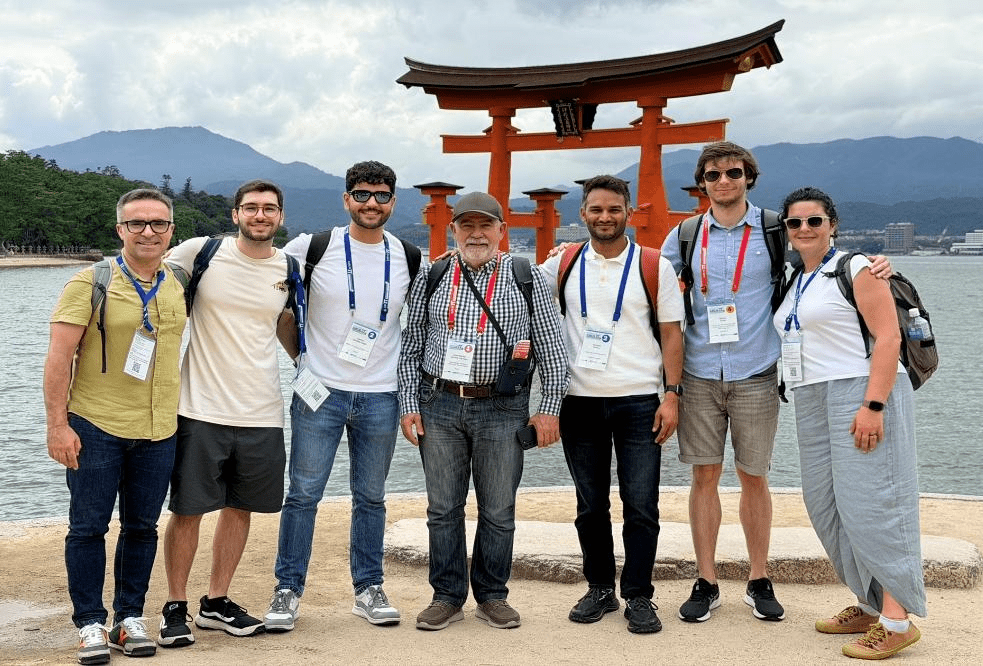
The EARLICOST community has come together in Athens for the EARLINET GA & EARLICOST WG & MC Live Meeting, taking place from 8–11 September 2026.
138 participants from 26 countries have joined us in Athens, bringing together researchers from across Europe and beyond for four days of scientific exchange, collaboration and community building.
Over the coming days, the programme will bring together the EARLICOST Working Groups, Management Committee and the wider EARLINET community, with scientific presentations, grantee flash talks, Working Group sessions, engagement with industry, and discussions on exploitation, dissemination and the priorities ahead.
Today, we begin by bringing the community together, sharing progress across the Action and its Working Groups, and setting the stage for the discussions to come.
From 8–11 September 2026, the EARLICOST community will meet in Athens for four days dedicated to atmospheric lidar science, collaboration and the future of our growing European network.
The programme will bring together the EARLICOST Working Groups and Management Committee alongside the EARLINET community, with scientific presentations, grantee flash talks, dedicated Working Group sessions, engagement with industry and discussions on exploitation, dissemination and outreach.
The meeting will also provide an opportunity to reflect on EARLICOST’s first year and jointly shape priorities for Year 2.
We look forward to welcoming the EARLICOST community to Athens!
EARLICOST COST Action is offering a new funding opportunity to support virtual networking, collaboration, and knowledge exchange across the Action.
Available Grant:
Virtual Network Support (VNS) Grant – Support for the strategic development of virtual networking practices within EARLICOST, including the development of a Virtual Networking Strategy and the conceptual design of the EARLICOST Virtual Knowledge Base.
Important Dates:
Application deadline: 06 September 2026
Notification of Results: 10 September 2026
VNS Activity Period: 10 September 2026 – 16 October 2026
A strong EARLICOST presence was on display at the EarthCARE Science and Validation Workshop, held in Oxford on 8–12 June 2026. The event marked another milestone in the European Space Agency’s exciting collaboration with the Japan Aerospace Exploration Agency, JAXA, who have teamed up to shed light on the mysteries of our climate system through EarthCARE (Earth Cloud, Aerosol and Radiation Explorer). The satellite carries four instruments, an atmospheric lidar, cloud profiling radar, multispectral imager and broadband radiometer, which were all put under the spotlight now that data products are all publicly available.
More than twenty EARLICOST members took part in the workshop, showcasing their latest research, exchanging ideas with leading international experts, and bringing home new knowledge and collaborations. Among them was EARLICOST Chair Eleni Marinou, who presented the validation of EarthCARE products within the ACROSS Mediterranean activities. Her work demonstrated how fully equipped atmospheric supersites can provide the high-quality measurements needed to validate satellite observations and maximise their scientific impact.
Another highlight was a presentation by Franco Marenco, supported through an EARLICOST Inclusiveness Target Countries (ITC) grant. His work addressed one of the key challenges in atmospheric remote sensing: translating EarthCARE’s optical measurements into reliable estimates of aerosol concentration. The presentation showed how uncertainties in particle size can propagate into the conversion factors, a challenge that becomes particularly important during major desert dust outbreaks, when exceptionally large particles are present in the atmosphere.
Throughout the week, discussions emphasised the crucial role of accurate observations, dedicated validation campaigns, innovative synergistic retrieval techniques, and international collaboration in producing high-quality climate data records that scientists and policymakers can trust. The workshop also featured a lively Early Career Scientist discussion forum, providing young researchers with a unique opportunity to debate some of the biggest open questions in atmospheric science, exchange ideas with senior experts, and expand their international professional networks.
With more than twenty members actively contributing through presentations and discussions, EARLICOST demonstrated the strength of its scientific community and its growing recognition within the international EarthCARE community. As the mission enters its exciting operational phase, EARLICOST researchers are helping ensure that its observations are transformed into robust scientific knowledge for the benefit of climate research worldwide.
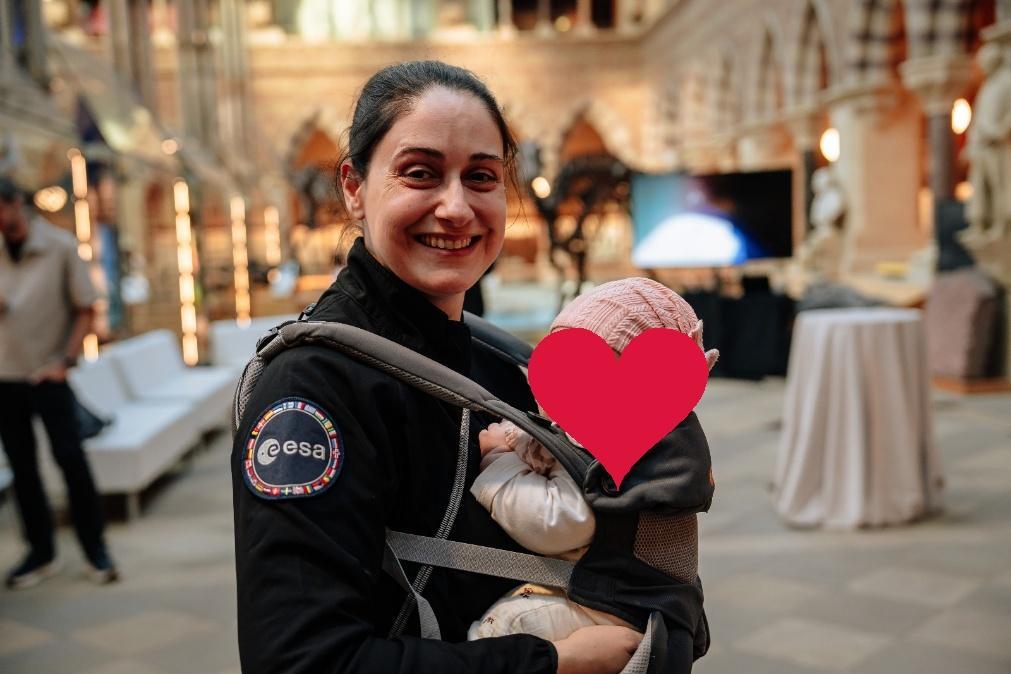
EARLICOST chair Eleni Marinou with her young daughter at the workshop dinner in the Oxford University Museum of Natural History.
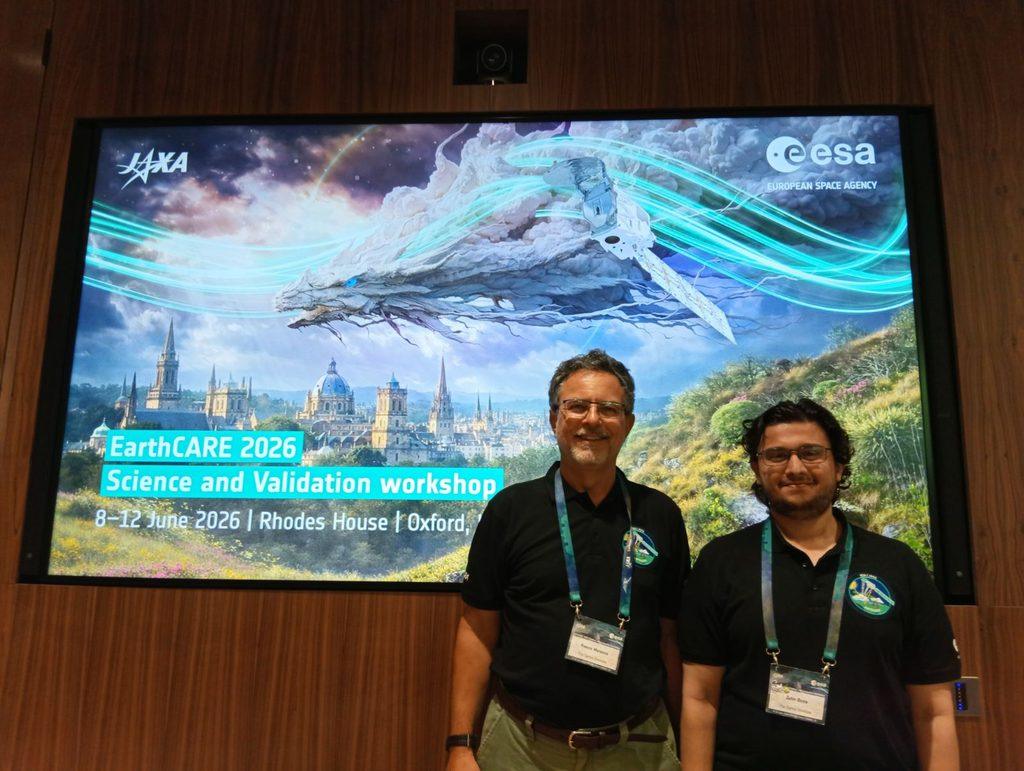
Franco Marenco and Zuhir Bona, both EARLICOST members, were also representing the Doctoral Network on Atmospheric Dust (Dust-DN)
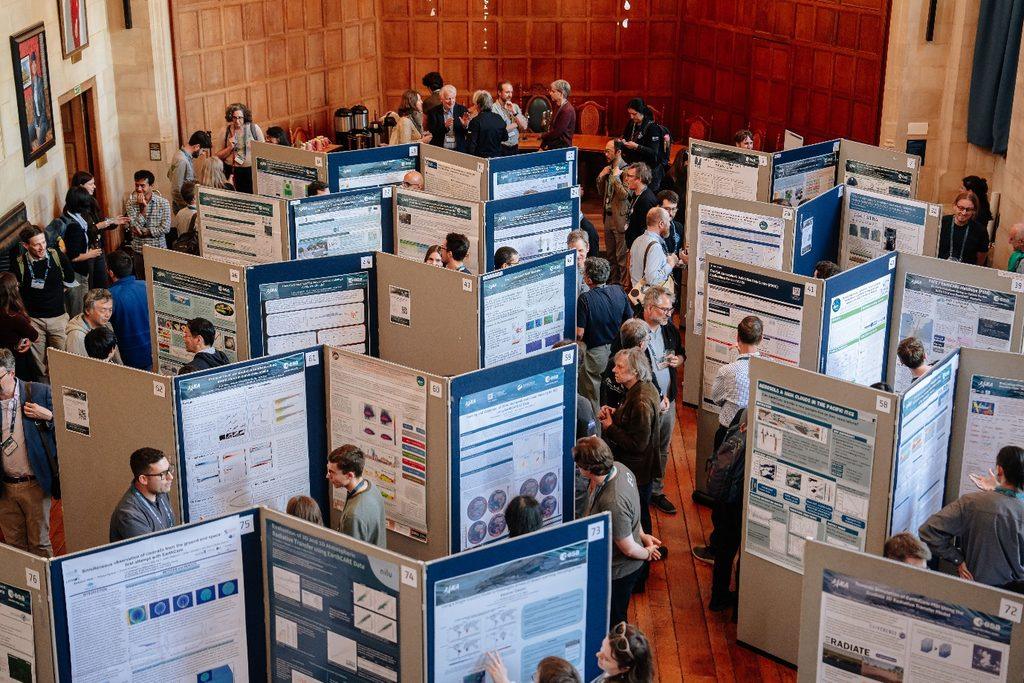
A busy poster session in Rhodes House, Oxford!
The EARLICOST members who participated in the EarthCARE 2026 Science and Validation Workshop with oral presentations and/or posters were:
Andreas Karipis — Poster: EarthCARE stratospheric aerosol optical depth and its impact on ICON forecast
Aspasia Pallikaridou — Poster: Validation of EarthCARE MSI and ATLID aerosol products in Eastern Mediterranean using AERONET and CARO observations | και Poster P082: Assessing MONARCH Mineral Dust Forecasts with EarthCARE ATLID and CARO Limassol PollyXT
Diego Alves Gouveia — Poster: Use of ACTRIS/EARLINET correlative observations for the validations of ATLID’s AER and EBD L2 products in cirrus clouds (EVID14)
Dimitra Kouklaki — Presentation: Quantifying 3D radiative transfer effects of clouds using ML-generated 3D cloud scenes for EarthCARE, and airborne observations from ORCESTRA/PERCUSION campaign
Eleni Marinou — Presentation: Validation of EarthCARE products under ACROSS Mediterranean activities | και Co-chair των Validation Recommendations της Day 5
Francisco Navas Guzmán — Poster: Assessment of ATLID Aerosol Vertical Profiles Using Synergistic Integration of the E-Profile and AERONET Networks | και Poster P038: Validation of EarthCARE-derived Planetary Boundary Layer Height using radiosondes
Franco Marenco — Presentation: Quantifying atmospheric aerosols using EarthCARE
George Kotsias — Poster (online): Early Insights into Cloud Vertical Structure over Cyprus from EarthCARE CPR Level-2 Products
Holger Baars — Presentation: Validation of EarthCARE’s ATLID L2 aerosol profiling products with ground-based lidar stations of PollyNET – case studies
Ioanna Tsikoudi — Poster (online): Evaluating EarthCARE Cloud Typing and Microphysics with Cloudnet data
Iwona Stachlewska — Presentation: Validation of EarthCARE ATLID L2 ESA and JAXA data products on over Poland using mobile EMORAL and stationary PollyXT observations | και Poster P063: Spatial distribution of dust-influenced elevated aerosol layers from PollyXT-UW and ATLID observations
Kalliopi Artemis Voudouri — Poster: Evaluation of EarthCARE aerosol layer height retrievals with ground-based measurements and collocated satellite data
Marco Di Paolantonio — Presentation: The OCEAN (Ocean Color EarthCARE ANalysis) project
Maria Poutli — Poster (online): Validation of EarthCARE ATLID L2a aerosol products with PollyXT Lidar Measurements at CARO Limassol ACTRIS National Facility
Martin Wirth — Presentation: Validation of ATLID extinction and lidar-ratio of cirrus clouds using airborne measurements with the research aircraft HALO
Moritz Haarig — Presentation: The global variation of the dust lidar ratio as observed with ATLID | και Παρουσίαση T217: Breakthrough in ATLID’s polarization characterization
Silke Gross — Poster: Airborne high spectral resolution lidar measurements to validate EarthCARE’s ATLID L1/L2 optical properties; update and statistical analysis | και Παρουσίαση T508: Transition from CALIPSO to EarthCARE; can we use EarthCARE measurements to continue CALIPSO long-term studies on aerosol effect on cirrus clouds?
Thanasis Georgiou — Poster: Improving desert dust emission schemes through novel data assimilation techniques using EarthCARE | και Παρουσίαση T421: Advances in dust optical modelling and EarthCARE dust data assimilation
Ulla Wandinger — Poster: POLIPHON implementation in the earthcarekit software tool: microphysical and cloud-relevant aerosol properties from EarthCARE/ATLID | και Co-chair/speaker στα Validation Recommendations Day 5 (S512)
Zuhir Bona — Poster: A Polarimetric Lidar Extinction Method for Improved Dust Retrievals from EarthCARE
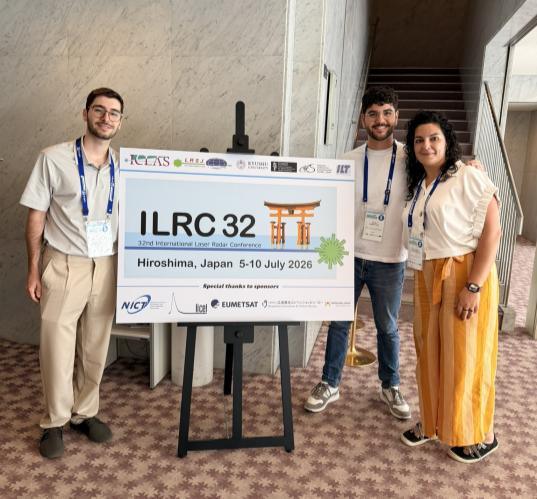
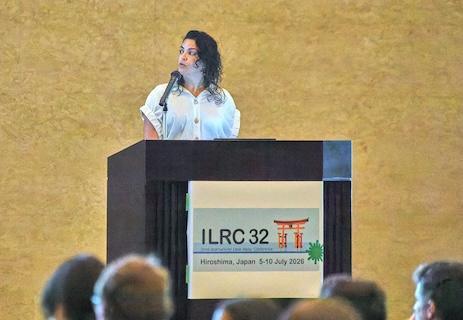
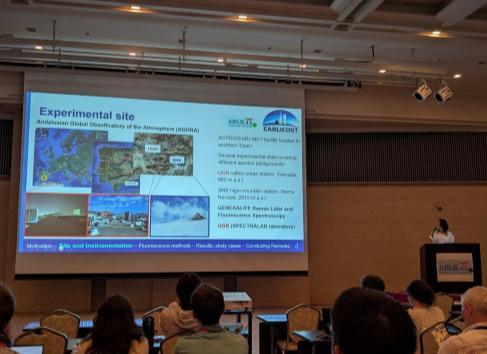
Through an EARLICOST Dissemination Conference Grant, Sol Fernández-Carvelo, PhD student in the Atmospheric Physics Research Group (GFAT), Department of Applied Physics, University of Granada (UGR), Spain, participated in ILRC 2026 and presented his research on advanced lidar techniques for aerosol characterization.
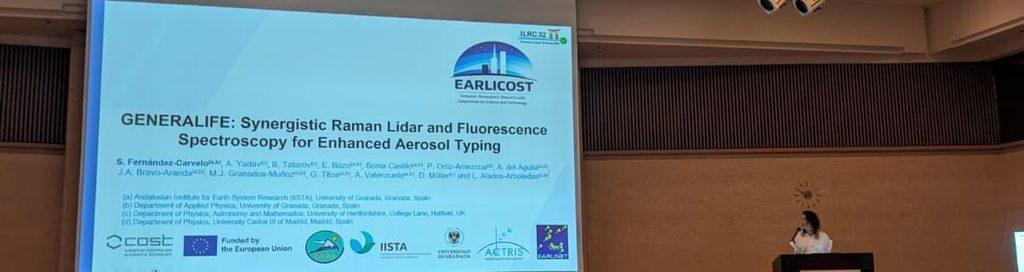
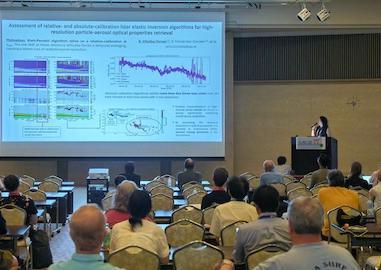
At the conference, Sol presented “GENERALIFE: Synergistic Raman Lidar and Fluorescence Spectroscopy for Enhanced Aerosol Typing”. Sol also presented work led by Samuel Villalba-Torres on high-resolution elastic lidar inversion techniques.
The conference provided an important opportunity to share EARLICOST-related research with the international lidar community, exchange expertise, strengthen existing collaborations and explore new opportunities for joint work across institutions and countries.
“Thanks to an EARLICOST Dissemination Conference Grant, I participated in ILRC 2026, where I presented our work, ‘GENERALIFE: Synergistic Raman Lidar and Fluorescence Spectroscopy for Enhanced Aerosol Typing’, exploring the combination of Raman lidar and fluorescence spectroscopy for improved aerosol characterization. I also presented work led by Samuel Villalba-Torres on high-resolution elastic lidar inversion techniques. ILRC 2026 was a great opportunity to promote EARLICOST, exchange knowledge with the international lidar community, strengthen existing scientific connections, and establish new ones. The support provided by EARLICOST facilitates the participation of early-career researchers in international events, increases the visibility of their research, and creates valuable opportunities for networking and future collaborations across institutions and countries. These exchanges opened up possibilities for joint work on fluorescence lidar, calibration, aerosol classification, and synergies between ground-based and satellite observations. I am grateful to EARLICOST and COST for supporting my participation and helping to strengthen international cooperation within the lidar community.”
— Sol Fernández-Carvelo, PhD student in the Atmospheric Physics Research Group (GFAT), Department of Applied Physics, University of Granada (UGR), Spain.
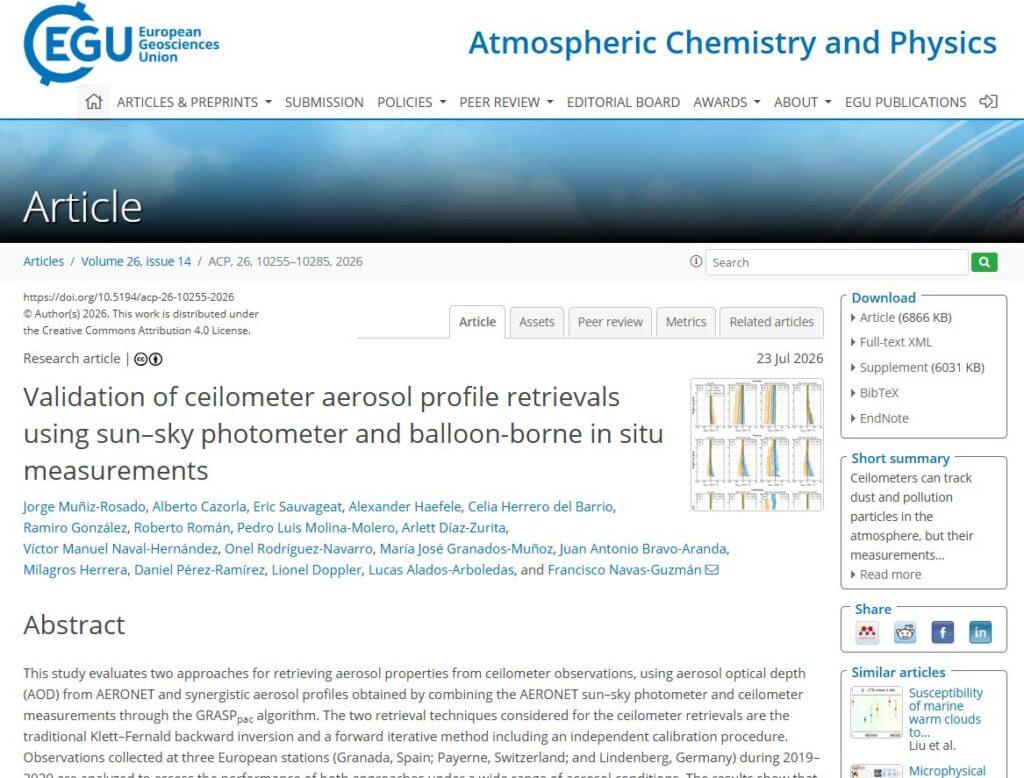
We are pleased to share a new publication supported by COST Action EARLICOST (CA24135).
“Validation of ceilometer aerosol profile retrievals using sun–sky photometer and balloon-borne in situ measurements” — published in Atmospheric Chemistry and Physics (Copernicus/EGU).
This study evaluates the capability of operational ceilometers to retrieve aerosol backscatter and extinction profiles through a comprehensive evaluation against independent reference datasets.
Key highlights from the study:
Two retrieval approaches are compared: the traditional Klett–Fernald backward inversion and a forward iterative method with independent calibration, evaluated against synergistic GRASPpac products and balloon-borne COBALD in situ measurements
Observations were collected at three European stations with contrasting aerosol regimes: Granada (Spain), Payerne (Switzerland), and Lindenberg (Germany) during 2019 – 2020
The forward iterative approach generally provides better agreement with reference datasets than the Klett–Fernald backward approach
Under high aerosol load conditions, particularly during coarse-mode-dominated events, the forward retrieval reduces AOD uncertainties by ~50% and achieves root-mean-square errors comparable to those reported in previous validation studies
The forward method maintains consistent accuracy throughout the troposphere, whereas the backward approach exhibits altitude-dependent biases, especially within dust layers
COBALD balloon-borne backscatter measurements confirm that the forward retrieval reproduces observed aerosol structures within 10% – 30% deviation
The results support the integration of forward iterative ceilometer retrievals into existing observational networks such as E-Profile and ICENET, enhancing regional and continental aerosol monitoring capabilities.
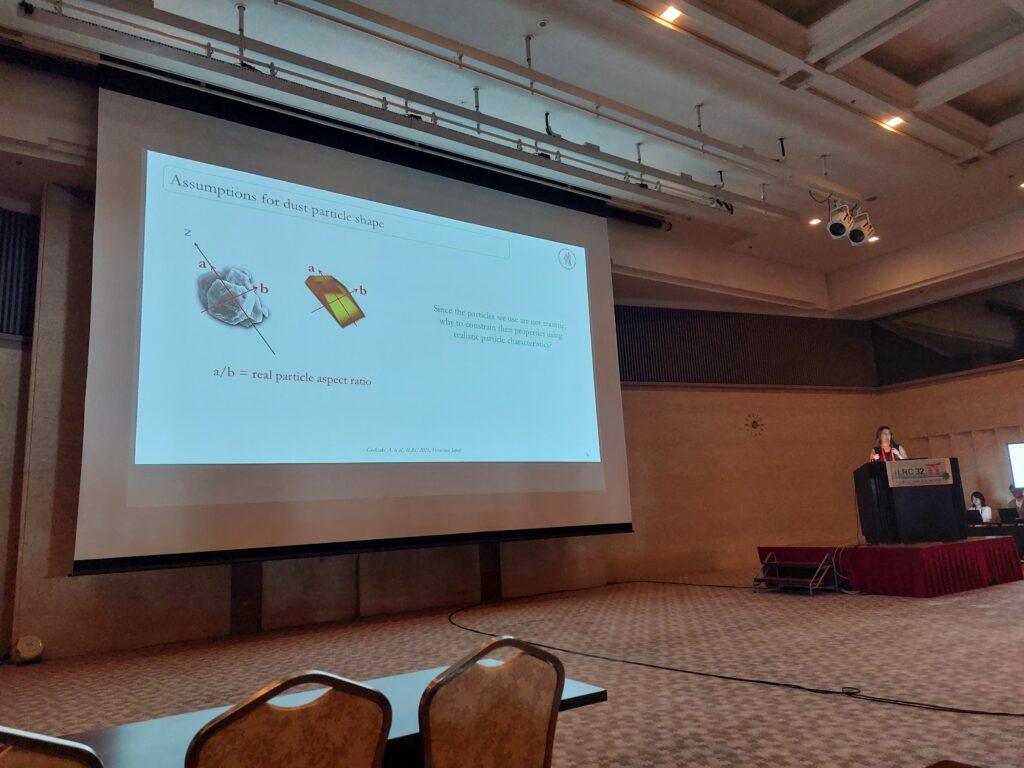
Meet Dr. Anna Gialitaki, Postdoctoral Researcher at IAASARS, National Observatory of Athens, Greece, who received an EARLICOST ITC Conference Grant to participate in the 32nd International Laser Radar Conference (ILRC32), held in Hiroshima, Japan from 5–10 July 2026.
At the conference, Anna presented “Reproducing Dust Spectral Backscatter Using Simple Shape Mixtures” as an oral presentation, sharing research on the development of a new dust shape model based on ensembles of spheroidal and irregular hexahedra particles in random distributions, to reproduce the spectral polarimetric backscattering properties of irregularly shaped desert dust particles with the international scientific community. The grant provided an opportunity to present and discuss her research results, to connect with experts working on atmospheric lidar, aerosol remote sensing, and dust optical properties, to increase the visibility of both her work and EARLICOST and to explore opportunities for future scientific collaborations.
“The study was received well by the scientific community that participated in the ILRC conference.”
– Dr. Anna Gialitaki
Participation in ILRC32 contributed to the advancement of Anna’s research, expanded her scientific network and created opportunities for future collaboration.
We are pleased to present Dr Marco Di Paolantonio, a Post-Doctoral Researcher at ISMAR-CNR, Rome, Italy, who received an EARLICOST grant to attend the 32nd International Laser Radar Conference (ILRC32), held in Hiroshima, Japan, from 5–10 July 2026.
Marco presented his research on “Preliminary results from the Lidar-based Atmospheric Measurement at Pianosa (LAMP) field campaign”, focusing on the characterisation of marine-influenced atmospheric conditions in the Central Mediterranean using the MARCO Raman lidar system, which provides high-resolution profiles of aerosol optical properties, clouds, temperature, and water vapour.
The grant enabled him to exchange ideas with colleagues working on similar topics, build connections that go beyond email exchanges, and deepen his understanding of the broader lidar community’s challenges and directions.
“Attending this kind of conference in person is truly valuable: it gives you the opportunity to learn a lot, exchange ideas, and, most importantly, meet and get to know colleagues working on similar topics. I am really grateful for the opportunity EARLICOST provided me to take part in ILRC through the YRI grant!”
– Dr Marco Di Paolantonio
Through initiatives like the Young Researcher and Innovator Grant, EARLICOST continues to invest in the scientists shaping the future of atmospheric lidar research.
We are proud to introduce Víctor Manuel Naval Hernández, a PhD Student at Universidad de Granada, Spain, one of the young researchers supported by an EARLICOST grant to attend the 32nd International Laser Radar Conference (ILRC32) in Hiroshima, Japan (5–10 July 2026).
Victor presented his work on “Towards Operational Monitoring of Tropospheric Water Vapour with the Dual-Field Raman Lidar ALHAMBRA”. His research aims to obtain an improved characterisation with high vertical and temporal resolution of the distribution of water vapour in the atmosphere using the Raman lidar technique, with the ALHAMBRA system operating in Granada, Spain
The grant enabled him to exchange insights with leading international researchers, strengthen his scientific communication skills, forge new collaborations within the lidar community, and raise the profile of early-career work across the EARLICOST network.
“with the help of the YRIC grant, I was able to share my research about thermodynamic profiling with Raman lidar with the rest of the lidar community. Additionally, I was able to establish new links with the rest of the ERALICOST researchers working on the same topic.” – Víctor Manuel Naval Hernández
Through initiatives like the Young Researcher and Innovator Grant, EARLICOST continues to invest in the scientists shaping the future of atmospheric lidar research.
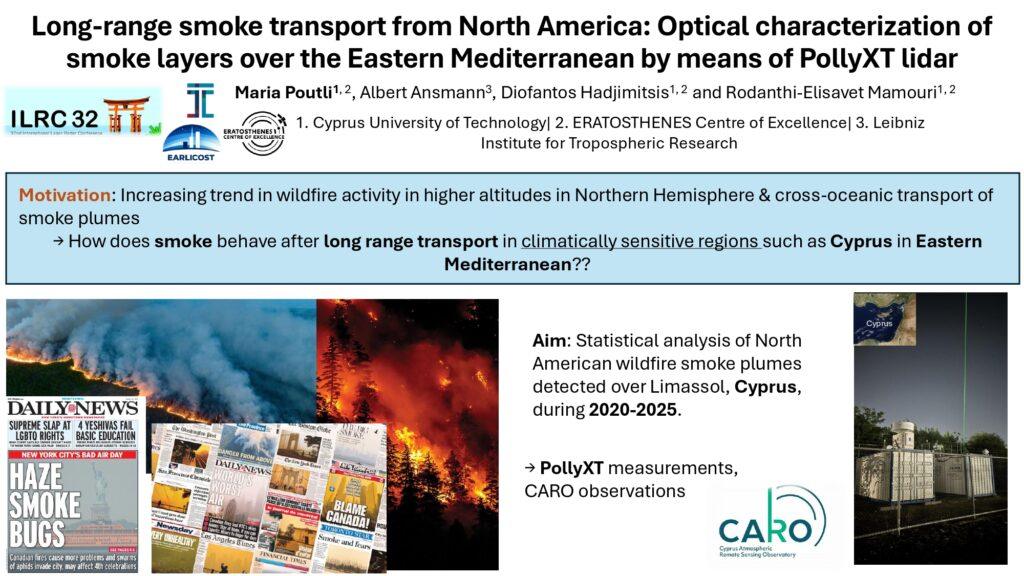
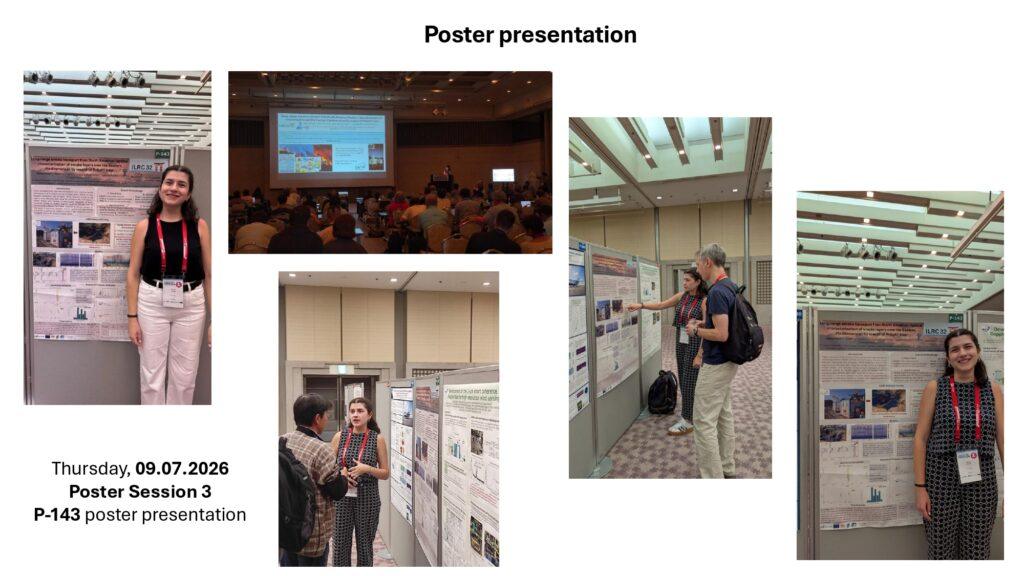
With the support of an EARLICOST Young Researcher and Innovator Conference Grant, Maria Poutli, a PhD student in Environmental Physics at the Department of Civil Engineering and Geomatics, Cyprus University of Technology, participated in the 32nd International Laser Radar Conference (ILRC32), held in Hiroshima, Japan, from 5–10 July 2026.
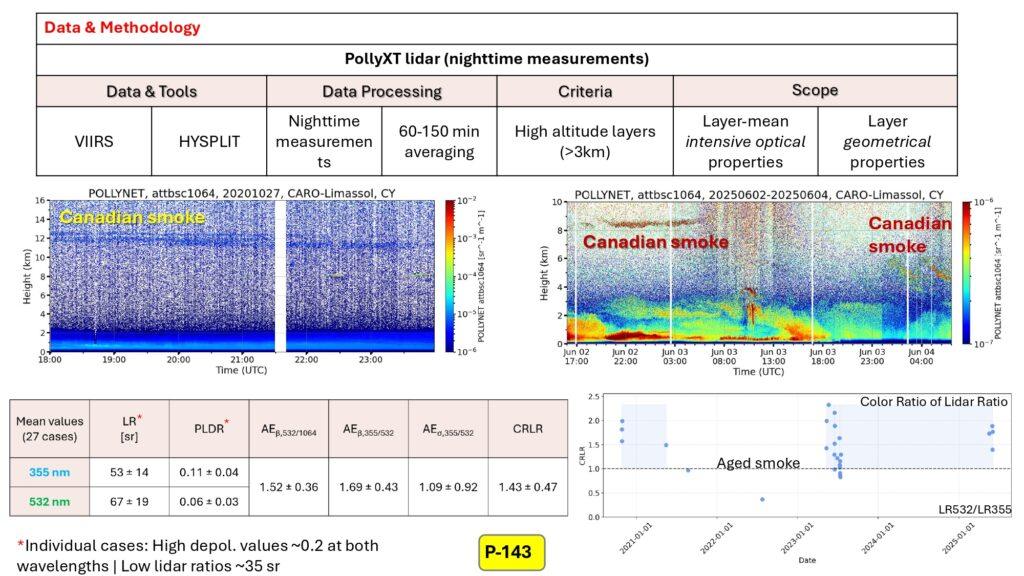
Maria presented research on “Long-range smoke transport from North America: Optical characterization of smoke layers over the Eastern Mediterranean by means of PollyXT lidar”, focusing on wildfire smoke events detected by the PollyXT Raman lidar in Limassol, Cyprus, during 2020–2025. The retrieved optical properties were generally consistent with values reported in the literature while also revealing distinctive observations, particularly regarding the lidar ratio and particle linear depolarization ratio.
Presenting this work at ILRC32 gave Maria the opportunity to discuss her findings with experts in atmospheric remote sensing, receive feedback on her research approach, and connect with researchers working on lidar observations, aerosol characterization, and long-range smoke transport.
“Overall, my participation in the conference strengthened my scientific background and enhanced my understanding of current developments, methodologies, and research approaches in the field of atmospheric remote sensing. Furthermore, it increased the visibility of my work, facilitated interactions and potential collaborations with fellow researchers, and improved my communication and presentation skills through both the poster presentation and the flash talk.”
– Maria Poutli
Maria’s participation reflects EARLICOST’s commitment to supporting young researchers, strengthening international scientific exchange and increasing the visibility of emerging research within the atmospheric lidar community.