WG1 Highlights: Advancing Innovative Lidar Technologies: High Spectral Resolution Lidars (HSRL), Fluorescence Lidars, Thermodynamic Profiling Systems
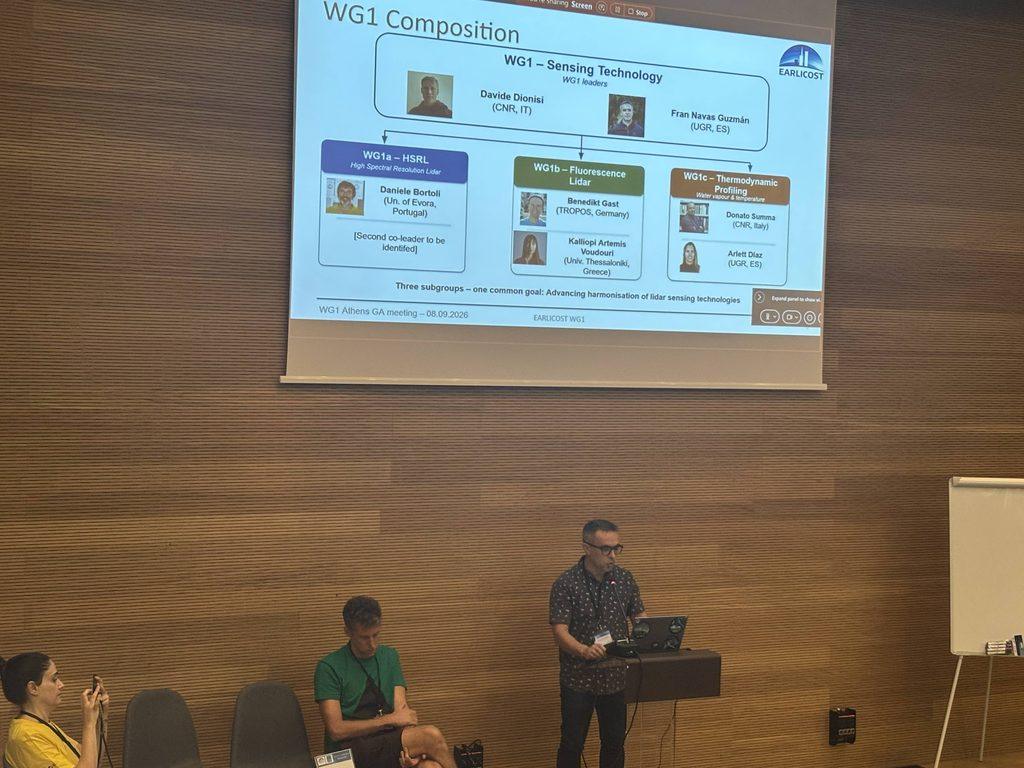
WG1 aims to advance and harmonise innovative lidar sensing technologies, improve data quality and uncertainty characterisation, and move towards common products, procedures and best practices across the EARLICOST community. Its activities focus on three main areas: High Spectral Resolution Lidar (HSRL), Fluorescence Lidar and Thermodynamic Profiling.
During its first year, Working Group 1 (WG1) has focused on creating scientific and technical hubs where expertise on innovative lidar techniques and technologies can be shared across the EARLICOST community. From launching community surveys to coordinating activities with initiatives such as ACTRIS, WG1 has established the basis for more focused and coordinated technical work in Year 2.
WG1 Participation:
WG1 has attracted strong interest from the outset, with 91 participants expressing interest in the group’s activities. Notably, 27 of these participants—30% of the total—are Young Researchers, reflecting EARLICOST’s strong commitment to capacity building among early-career scientists. Of the full participant pool, 22 individuals are exclusively engaged with WG1, signalling a critical mass with a high level of dedicated commitment, while the group’s open, interdisciplinary structure allows members to contribute across multiple working groups simultaneously.
This diversity of engagement has been supported by the COST grant programme. Over the course of the year, WG1 activities benefited from five Young Researcher and Innovator Conference grants, three Inclusiveness Target Countries Conference grants, one Dissemination Grant, and one Short Term Scientific Mission (STSM)—concrete evidence of how the network is translating its inclusiveness goals into real opportunities for participants.
Sharing Expertise and Coordination:
WG1’s first year of activity has been structured around a series of key meetings designed to build momentum and consensus. The group’s introductory meeting, held on 21 January 2026, marked the formal start of WG1 activities, with participants working to finalise the composition of sub-working groups and identify priority topics and planned activities.
This was followed by a 1.5-day focused WG1 online meeting on 25–26 March 2026, which served to consolidate the findings of the group’s technical survey and align priorities across the community, while also launching hands-on technical activities among members.
Coordinating with ACTRIS
Recognising the value of avoiding duplication of effort, WG1 has worked closely with the ACTRIS research infrastructure to align activities.
Using the EARLINET – COST survey on lidar systems, algorithms and techniques as a common basis, the two networks agreed on joint priorities including harmonised setups, intercomparisons and best-practice recommendations.
Mapping the Community’s Capabilities: Deliverable 1.1
Central to WG1’s first-year progress is Deliverable 1.1, a survey designed to provide an initial overview of the current capabilities and priorities of the EARLICOST WG1 community across three key technology areas: High Spectral Resolution Lidar (HSRL), Fluorescence Lidar, and Thermodynamic Profiling. The survey examined system configurations, data analysis algorithms, available software, and broader community needs.
The results revealed a community rich in diversity but in need of greater coordination. Systems across the network are heterogeneous, with varying levels of maturity and configuration. Data processing remains fragmented, relying heavily on institution-specific algorithms and software, while gaps in calibration, uncertainty estimation, and quality assurance/quality control point to a clear need for alignment.
At the same time, the survey highlighted a shared opportunity: the potential to build common repositories, benchmarks, and intercomparison exercises. Taken together, Deliverable 1.1 provides the essential baseline needed to support coordinated harmonisation across the network in the years ahead.
From Athens 2026 to Year Two:
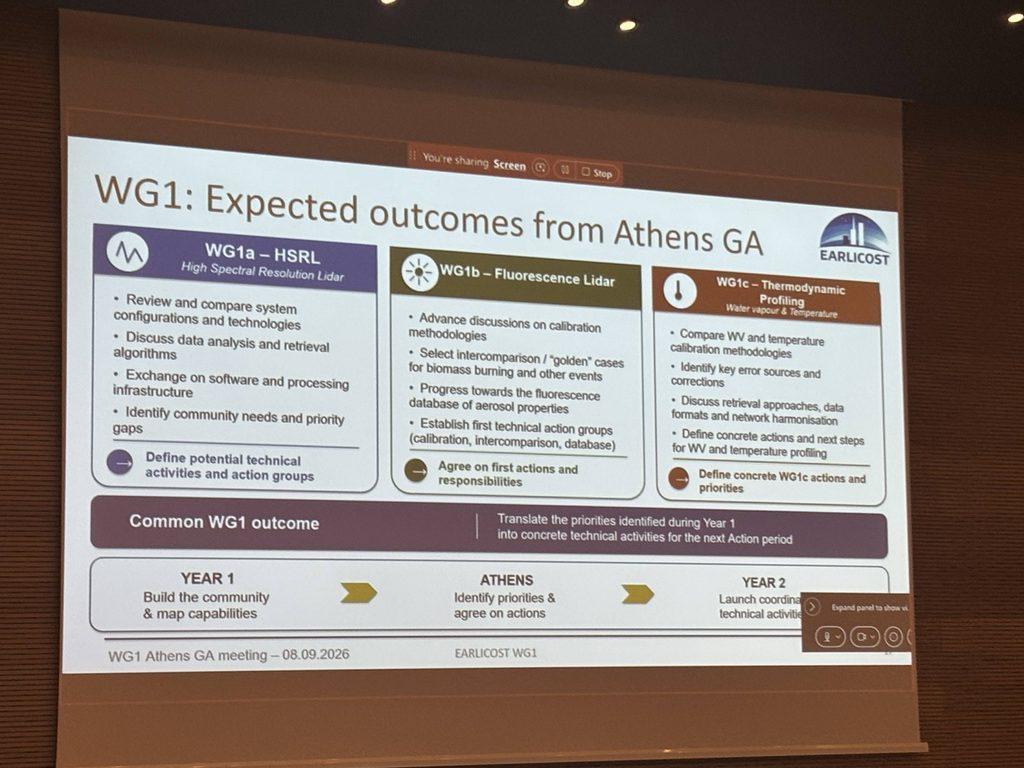
The Athens General Assembly marked an important transition for WG1, moving from mapping the community and identifying common needs towards defining concrete technical activities for Year 2.
Each sub-working group has defined clear goals: WG1a (HSRL) will review and compare system configurations and technologies, discuss retrieval algorithms, exchange on software infrastructure, and identify priority community needs.
WG1b (Fluorescence Lidar) will advance calibration methodologies, select intercomparison “golden cases” such as biomass burning events, progress the fluorescence database of aerosol properties, and establish the first technical action groups.
WG1c (Thermodynamic Profiling) will compare water vapour and temperature calibration methods, identify key error sources, and define concrete next steps for harmonising retrieval approaches and data formats.
These efforts reflect the broader arc of WG1’s journey: Year 1 has been about building the community and mapping its capabilities; the Athens meeting will be the moment to identify shared priorities and agree on concrete actions; and Year 2 will see the launch of coordinated technical activities that turn this first year’s insights into lasting, network-wide impact.